Translate

Wednesday, May 10, 2017

More Thoughts about Happiness

Awhile ago I published an essay about "Happiness" and what it means to me. Today I came across a quote from Franklin D. Roosevelt that says a lot about the subject in just a few words:

"Happiness lies in the joy of achievement and the thrill of the creative effort."

In terms of quilting, whenever I have attempted to do something I have never done before, such as making a miniature "Double Wedding Ring" quilt, and have succeeded, there is a certain "joy of achievement." Anything difficult or new is worth trying. We all have our own learning curve and are on our own journeys as quilters.

"Double Wedding Ring" miniature quilt


I was thrilled when I succeeded in making a final quilt for the Embroiderer's Guild of America's "Master Craftsman Program," a testing program, not a class. The creative effort I put forth was great and was a reward in itself for the "thrill" of knowing I did a good job. I was very excited in the year 2000 when I received an e-mail with the coveted word, "Pass" for my quilt "Sunset Serenity at Mt. Fuji." Just one word of praise was sent but that was enough. The long nine year journey toward seeking the title was over!

One does not have to be a quilter to find fulfillment in achievement. Tonight on the television news there was word of an octogenarian who is going to receive a college degree shortly. She had started college but had quit due to becoming married. It was always in her heart to finish and now she will get her wish.

Life is always about starts and finishes. Tonight I am feeling happy to have finished writing a memoir about my own life. There were troubled and turbulent times but I never gave up and never gave in and have had much success in quilting, writing and publishing.

Achievement takes a lot of hard work but achievement is at the heart of happiness. We do not have to measure success in grand terms. Baking a fantastic cake can be as satisfying as climbing a mountain.

Franklin D. Roosevelt knew a thing or two about achievement and the happiness that it brings. Just look at his record of "overcoming" his handicap to be one of the greatest presidents America has ever seen! He lifted America out of the Great Depression in the 1930s and used his creative imagination to establish the Civilian Conservation Corps whose work we still enjoy in the National Parks system.

Doing a good job is what life is all about. Sometimes we are paid for our creativity and work and sometimes we do work just for the satisfaction of producing something tangible that is ours alone.

I hope that you will think about happiness and what it means to you. If you have any ideas you want to share, please feel free to comment!

Happy Quilting!

Patricia Cummings


Wednesday, April 26, 2017

The Nubble Lighthouse

From York Beach, Maine one can see the Nubble Lighthouse at the end of land jutting out into the Atlantic Ocean. One can drive out to the Lighthouse and it is beautiful in any weather. This week, on a sunny day in April, we took the opportunity to drive from New Hampshire to Maine, stopping at Bob's Clam Hut in Kittery, Maine, a famous restaurant of ours for years now. It was a grand day!

The Nubble Light / photo by James Cummings


In 1994 I took a photo of the Nubble Lighthouse in the winter and made a miniature quilt with a photo transfer.


The Nubble Light in Winter / a quilt by Patricia Cummings


Saturday, April 22, 2017

Poem: You Know that You're a Quilter

You Know that You're a Quilter
a poem by Patricia L. Cummings

You know that you're a quilter
When your home could be a shop
So filled it is with notions
and cloth from Fabric Hops.

You know that you're a quilter
When you need a live-in-chef
To remind you of the need to eat
When you'd rather just be left...

To mark and cut and piece and quilt
And sing the whole day through.
You know you are a quilter
AND the things you like to do!

Your children sleep under quilts
that you have made with care.
Your husband wears a quilted vest
Even though others stare.

Your toaster sports a cover,
Quilted with your two hands.
As you work on finishing a quilt
yet another one you plan.

The world is prettier still
Due to quilts that you have made.
They adorn every surface
in homes that are humble or grand.

Doll quilts, wall quilts
And bed quilts, too,
Greet visitors and loved ones
And they're all made by you.

To all quilters now we say:

May your blessings be many,
And your troubles be few.
Take time today to celebrate
All that you do!


###

Thursday, April 13, 2017

Calico Garden

One of the most favorite quilts I ever made is called "Calico Garden" and is a reproduction of a quilt made by Florence Peto in the 1950s. She was a quilt dealer from New Jersey and a quilt historian who was a consultant for the Shelburne Museum when that museum was amassing its quilt collection.

"Calico Garden" 39" x 49"


The quilt took me a year to make. It is pieced, appliqued, and hand-quilted. I used the pattern provided by Hoopla, a company owned by Froncie Quinn. The swags and border flowers are made from chintz fabric and are much larger than the ones on the original quilt that is now held by the Shelburne Museum. I did submit documentation and a photo of the quilt to the museum for their records. A documentation sheet came with the pattern. I finished this quilt in September 2001.


Tuesday, April 11, 2017

Spring is Here!

After a long winter during which we had a lot more snow than last year, April is here! Finally, we are seeing some Glory of the Snow (little blue) flowers, the first to bloom in our yard. We had been hearing about the baby animals at the Billings Farm & Museum in Woodstock, Vermont and decided it was time to visit there again. A few years ago, we wrote a magazine article about the place and so, we are fairly well acquainted with its history and offerings but listen, who can resist animals?

Here are some photos from our day trip.

Curious cow (Milking cows are leaner than animals raised for beef)

Baby lambs resting in their sweaters

Mother sheep catches a ray of sun while babysitting two lambs

Percheron horses enjoy some fresh air on a gorgeous spring day (yes, that is snow!)

Friendly sheep that did not mind being petted. All photos by James Cummings

Friday, April 7, 2017

Quilt Blocks Galore!


During the course of time that I was actively involved in magazine publishing, I made many quilt blocks to serve as illustrations. The blocks were of different sizes and I gave no thought to make them color-compatible to use in a Sampler quilt(s). Now I am left with piles of quilt blocks that are discordant to each other, some large enough to finish into its own small wall quilt or pillow (but how many small wall quilts or pillows does a person need?).

Many of the blocks I reproduced have a political or Biblical association. The following block was difficult to make. You will notice that it is made with half-square rectangles which took some time to master, piecing them by hand. The name "Ararat" is that of a new elephant at the Kansas City zoo at the time that the designer Eveline Foland created this block for publication. The block had no association with the Republican party at the time it was made in the 1930s, yet it has taken on that significance. The equivalent would be the quilt called "Democratic Donkeys." A vintage example of a quilt of that kind is shown in my book, Straight Talk About Quilt Care.

But back to my original dilemma: what to do with all of these loose blocks? I welcome any ideas!

"Ararat" block made as sample for a magazine article


Saturday, March 25, 2017

Announcement


Hello friends,

I have an announcement to make. I am in the process of taking down my main website which has been in place since 2002. For 15 years, Quilter's Muse Publications has provided quality educational articles and special features. At the moment, it is a shadow of its former self when there were many song files offered, crossword puzzles, quilt show reviews and so much more. In 2011, the site was badly-hacked and had to be re-established. I never quite recovered my momentum.

Then in 2014, The Quilter magazine for which I was a columnist for 15 years (since 1999) folded. Without traffic being driven to my site by constant exposure through the column, readership began to diminish. In addition to that, I have been unable to change, update or add new files to that site ever since the ownership of the server changed. It has been a frustrating experience in that regard but at one time, the site was a great joy to me and a major way to share my love of quilts and needlework.

As soon as I can manage it, I'll remove the website. I will continue, however, to write articles on this Google blog even though I am "retiring" from the other site. My love of old quilts and of the quilting process itself has not diminished. I have been quilting since 1985 and plan to continue doing so as long as my eyes and hands "hold up." Right now, neither of those are a problem. My eyesight is 20/20 and I have no issues with carpal tunnel or arthritis, thank goodness.

So, things change. Anyone can reach me at quiltersmuse@gmail.com if you wish to send me an e-mail.


Patricia Cummings


Wednesday, March 22, 2017

Old Quilt Holds Mysteries

“Civil War Era” Quilt Holds Mysteries

Patricia L. Cummings


"Civil War Era quilt" - collection of Patricia Cummings

If only quilts could speak to us, what a tale they could tell! When I spotted a quilt in
an  antiques mall with a tag that said “Civil War Era quilt,” I was hooked at first 
glance. Immediately, I loved its colors as well as its somewhat organized scrappy 
look. No further information is available about the quilter or the circumstances 
under which this 19th century quilt was made. Certainly, the fabric prints suggest 
the possibility of a Civil War time frame but without verifiable information, we 
shall never know all the details we seek. At any rate, by 1870, the patchwork look 
had run its course in popularity paving the way for the ornate Crazy Quilts and
Redwork quilts of the next decades.

Quilt Features: Clues or Coincidences?

The more I examined this quilt, the more my mind went wild with possibilities. 

The backing of the bed-size quilt is slit diagonally for about 22” and the cotton 
batting has been removed in that area along with the short ties that once held all
three layers of the quilt together. To me, it appears that someone could have been
looking for treasure inside the quilt. During the American Civil War, money and
other “treasures” such as silverware or jewelry were hidden inside Confederate 
quilts to keep them from the marauding eyes of Union soldiers who often 
scooped up anything of apparent value to take with them. I wonder if this quilt 
originated in one of the southern states. Perhaps, someone decided to investigate
to see what might be found inside! This is one mystery we shall never unravel!

The Importance of a “Scrap Bag”

Due to an embargo that restricted trade between the north and south during the 

Civil War, the south suffered from a shortage of cotton fabrics. This is one reason
that many of the extant southern Civil War quilts are either silk or made from 
scraps, often from clothing. Women would cut up their dresses, just as they did in
the north, to recycle fabrics due to the scarcity of fabrics.

Pieces of Pieces!

In the quilt shown here, pieces of the quilt are they themselves pieced, as are the

borders, suggesting that the quilter worked from a scrap bag of recycled cloth to 
create strips, triangles and squares. In spite of the wonky piecing, the quilter 
managed to make a finished quilt that is nearly square: 82 3/8” x 83 5/8”. The 
borders of this quilt are variable in size (3 ¾” on the sides and 2 7/8” at top and
bottom). In this “well-loved” quilt, the clue that the quilt looked like this 
originally and does not have repaired borders is the fact that there is a“knife 
edge” finish all the way around.

Color Planning Shows Genius

Overall, the placement of colors in this old quilt is aesthetically-pleasing. The

double pink squares and triangles juxtapose well with the rich brown fabrics 
and indigo color squares and triangle. The quilter employs many neutral 
fabrics like light brown, gray, beige and tan and adds some strong geometric
prints. The quilter seems to have put a lot of thought into just how she would
arrange the fabrics she had at hand. The overall effect is balanced, a lot of 
work for “just” a utilitarian quilt.

Just Three Blocks

The quilt consists of three different geometric block configurations. There are

 (24) traditional Nine Patch blocks which are placed adjacent to (24) additional
blocks in which the corner squares of a Nine Patch block have been replaced 
with half-square triangle units in light and dark colors. The (1) center block is
a solo affair that has strips (unlike the others) and requires more intricate 
piecing of the side triangles, all of which have four interior triangles. All of the
blocks measure 10.5” square as a finished size.

Why Purchase Old Quilts?

What possessed me to purchase a quilt I shall never use? The reason is fairly

simple to those of us who love old textiles. Old quilts have a certain allure and
can present a kind of mystery. They are fun to “dissect” and study to see just 
how the quilter put them together, what types of fabrics she used and in the 
case of scrap quilts, how she worked magic from the limited materials that 
were accessible at the moment. This quilt, though very photogenic, now 
appears to be quite faded possibly from laundering or exposure to ultra-violet
rays of the sun.

Old quilts are a joy! We can imagine our own grandmothers, making do and

passing their days by crafting warm bed covers for their family. I offer the 
details and photo of the quilt here, just in case you are inspired to make a 
similar quilt. If you do, please do the next generations a favor. Make a tag for
the back of the quilt that indicates who you are, the date you made the quilt
and where you were located at the time. Future quilt historians will thank 
you! Of course, if this article does result in a new quilt you make,
photos are always welcome! Send to quiltersmuse@gmail.com

Happy Quilting!

A pattern for this quilt prepared by Patricia Cummings was published in
ScrapQuilts magazine.


Thursday, March 16, 2017

Rare Yellow Work Quilt Leads to Research


Rare Yellow Work Quilt Leads to Research

Patricia L. Cummings
Several years ago, a friend who loves quilts and Redwork embroidery came to visit. Little did I know that one reason for seeing me that day was to give me a rare quilt rendered in yellow thread rather than the customary red hue used for a technique called Outline Stitch Embroidery.


Sandra Munsey had acquired this treasure in 1990 from a quilt vendor, Mildred Fauquet, who was selling quilts at the Nebraska State Fairgrounds in a booth called “Raggedy Ann’s Antiques.” A city bus shuttle from the American Quilt Study Group seminar site in Lincoln, Nebraska had transported Sandra to the fairgrounds. She had seen a quilt of this type only once before in all of the years she has been collecting examples of outline-stitch embroidered quilts in different colors (Bluework, Greenwork, etc.). After previously letting a Yellow Work slip through her hands to another buyer, she decided to purchase this quilt, in spite of its lofty price. I was very elated to receive this gift!

Quilt Features Fine Stitches

This quilt is the work of an experienced needlewoman and is very well made and nicely hand-quilted. The Baptist Fan or Methodist Fan style of hand quilting (so designated according to one’s personal choice of religion) is employed over the surface of the blocks and sashes. The outer edge sashes form an enclosed frame around the center and the other two borders are added. The three strips together feature a zigzag diagonal quilting pattern. The quilting lines are spaced at ¾” intervals.

The overall quilt size is 76 1/8” x 79 3/8” with the individual blocks being an average size of 10 1/8”. Sashes are 2.5” wide, the first white border is 2.5” and the outer yellow border is 3 1/2”, including the outermost part covered by a separate 1/4” binding (the size visible on the front). The backing is the same yellow fabric used to construct the top. A curvi-linear botanical motif is repeated (7 times) on each side in the white border.

Designs on this Quilt

Floral motifs and other 19th century designs, including owls, a woman leaning forward to hand an umbrella and hat to an unseen person, a girl jumping rope, a Jack and Jill motif and the customary inclusion of spider webs, cattails and a water scene are seen. All of the designs are stitched with fine pearl cotton thread in a deep ochre color.

Typical 19th Century Motifs/ One Source Found

In searching for the source of some of the designs, I leafed through the J.F. Ingalls' catalog and found three of them. The block of two birds sitting on a pine branch is the reverse image of the design he calls #880. The price of that 7” x 9” patterns is listed as $.15 cents. The second design I found, a girl jumping rope, is reminiscent of Kate Greenaway’s work. (She was a British illustrator of children’s books). Listed as #823, the 4” x 8” design sold for $.10 cents. The third design offered by Ingalls is the one I call “three chicks in a boat.” Originally intended for making a “splasher” (to keep water from off the wall when one used a pitcher and basin to wash up in a bedroom), the design area was 12” x 25” and the price was a whopping $.50 cents!

Mindboggling Number of Sources for Designs

Encouraged by finding these designs, I looked through the many pages of the M. J. Cunning & Co. catalog with its 3,000 designs but found no matches there. That company bragged of offering the most designs for sale than any other company, the same claim made by their competitor, T. E. Parker. At the height of the Redwork phase in the 1890s-1920s, a trend that began in Kensington, England, quite a few women’s magazines for women offered designs as premiums for subscribing.

The book titled
Briggs Transferring Designs: Patented for the United States of America and published by J.F. Ingalls, Lynn, Mass. The back page of the 234 page book, full of all kinds of botanical motifs, stylistic letters of the alphabet, designs to decorate handkerchiefs and more, features an advertisement for Briggs’ Silks for Embroidery and states that they can be used with the transferring designs and are available from J.F. Ingalls. Other companies made offers for cloth to be used with their products.

Many companies offered collections of designs. A non-comprehensive list would include
magazines and journals such as
The Modern Priscilla, Ladies Home Journal, McCall’s
magazine and
Godey’s Lady’s Book, sometimes offering sets of free designs as a premium for new subscribers. The Montgomery Ward catalog, the Victoria Art Manufacturing Company (William Pinch), and Virginia Snow Studios (a.k.a. Grandma Dexter) were soon competing for their share of the market by offering designs.

Eva Niles capitalized on the needlework fad by writing her own book,
Fancy Work Recreations: A Complete Guide – Knitting, Crochet, and Home Adornment (Minneapolis, Minn.: Buckeye Publishing Co., 1884), in which she pirated Kate Greenaway designs, in some cases. One design in her “Outline Designs for Patchwork” is almost identical to a Greenaway design, yet no mention of the British artist is made. In the days before copyright was stringently enforced, any artist’s drawings were up for grabs. In fact, one magazine (that shall go unnamed) suggested that people trace Kate Greenaway designs directly from her books and from the look of some extant Redwork quilts, many ladies took that advice!

Designs Frequently Offered by Sales Catalogs

Common images of designs to be copied for embroidery were butterflies, musical instruments, sayings, religious icons such as Jesus or Mary, squirrels, owls, canes, vegetables growing animals, Nursery rhyme characters (often call kindergarten blocks and intended for children to embroider), and border edge motifs and corner fillers for square corners of doilies. Water scenes appear on many splashers, some of which feature herons, the rising sun, children jumping off a bridge into water, children in a rowboat, cattails, or sailboats at sea.

What is the Best Way to Transfer Designs? Companies Compete

Companies that sold designs also provided advice and products for transferring designs to fabric and in the 20th century, they began to sell linen already stamped with designs. Before that time,
The Art Amateur: A Monthly Journal Devoted to the Cultivation of Art in the Household provided a recipe for making a stamping paste.

The M.J. Cunning Co. includes a huge perforated pattern that is the same size as their oversize catalog (10 7/8” x 15 3/8” large) as a sample in their 1886 catalog.  One must hold it up to the light to see the design. In their 1905 catalog, they offered stamping pads to use as a dry stamping method. Other methods included wet stamping by soaking a wool cloth with gasoline, running it over stamping wax and in turn, rubbing it over the top of a perforated pattern weighted at each end. J.F. Ingalls sold a stamping paint. In addition, women found they could use flour, starch, charcoal with perforated designs, or pencil lead that filled a whole sheet of paper in order to transfer designs to cloth.

Let a Sewing Machine do the Work!

Sometimes, ladies would also draw their own designs and purchase a sewing machine attachment called “Little Wonder Perforator” to perforate their own paper. Presumably, a home sewing machine could do this work with an un-threaded large needle, reserved for just that purpose because over time, the needle would become dulled. A dressmaker’s tracing tool with saw-tooth edges could manually perforate the design lines. Failing that, M.J. Cunning Co. offered to perforate anyone’s design sent to him and charge prices similar to those seen in their catalog for designs the same size. The catch was that the company would consider those designs an acquisition to their own library of patterns and could very well include them in their next publication.

More Innovation during the Victorian Age

Briggs developed the iron-on transfer method which they first demonstrated at the Philadelphia Centennial Exposition of 1876. Iron-on transfers became the mainstay of companies like Aunt Martha Studios. The bold embroiderer could draw designs directly on the fabric with the indelible pens developed for inscribing quilts with signatures. Failing that, there were rubber stamps for imparting designs to fabric.

Skilled Transference of Designs

We do not know exactly how the quilter who made this quilt transferred her designs but the manner is imperceptible on the finished quilt. After checking all of the major catalogs and books in my personal library, I did not find any other exact matches for the designs of this Yellow Work quilt. At least one purveyor of patterns encouraged his clients to use their own creativity in combining designs.

Is this a Case of Humility or Humor?

There are two motifs that are purposely added in an upside down orientation. There are those people who believe in the myth that quilters included a “humility block” in the past, in order to show deference to the Almighty who is perfect in every way. As a quilter, I can safely say that this quilter either had a sense of humor or was doubly humble!

A Fun Research Project

As usual, I cannot undertake a research project without learning a lot more about old quilts. Unfortunately, we do not know the name of the lady who made this quilt in the early 1900s. Influenced by the designs that were all around her, the quilter put together this unique quilt that has been “well-loved.” At one point in time, someone apparently spilled ink on the surface. In an attempt to remove the stain, a harsh substance was used that did not totally succeed in that effort but also inadvertently removed some of the yellow color from the sash. Nothing and no one leaves this life unscathed, un-scarred or perfect. With these old quilts we have to love them for what they are even when we can only envision what they had been like when new. I hope you have enjoyed this special feature as much as I have enjoyed writing it.


Patricia Cummings is the author of books about Redwork and its History (as well as other books). She is an E.G.A. certified master craftsman in quilting, a quilt historian, a quilt judge and a free-lance writer.

Friday, March 3, 2017

Winter is for Hibernating

This winter I have been doing more reading than quilting. I read the entire 12 books of the continuing novel whose main character is "Ross Poldark." The series was written by the late British novelist Winston Graham. The books are so well written, they are riveting, if not lengthy. I first became interested after seeing the (first) televised series on PBS. The second series is to be offered later this spring. It will be interesting to see how much the plots align between the books and the televised version.

Pat hand quilting. Photo taken in 2015. This project is taking a long time!


Wholecloth Quilt Work Continues

Winter is the time for hibernating. We have enjoyed watching the woodpeckers at the suet feeder and I have found the opportunity to work on the queen size white wholecloth quilt that I am hand quilting. I prefer the straight lines to stitch rather than the curvilinear lines or "feathers."

Redwork Kit a Challenge!

The only other project I am currently working on is a Redwork design that features barn quilts. It is a kit that was purchased at Colonial Williamsburg and given to me by a well-meaning relative for Christmas. The work is very demanding, with stitches that are supposed to be only 1/8" large and with frequent stops and starts on the larger, main design as the one strand thread called for cannot be carried on the back more than 1/4". It means re-threading the needle constantly. The pattern also called for basting on a piece of batting to the back of the printed muslin before beginning work, an unusual and new-to-me way of working.

The "other" designs feature line drawings of actual barn quilts as documented by the book Barn Quilts. Coincidentally, I was also given that book by another party who had no idea that I would also be given the Redwork kit. There is a suggestion to make the 4" barn quilt designs into ornaments or to (somehow) add them to the main design that depicts the back of a boy and a girl looking at a barn that has a barn quilt. The instructions are very scanty and leave much (expertise) up to the (advanced) needleworker.

We cannot wait for gardening season. This is a view of one end of our herb garden.


Spring is on the Way!

Daffodils have peeked through the soil and are budded up here in New Hampshire just as temperatures are dropping to 20 degrees and below after a spring-like past week when the temperature high reached 73 degrees in Nashua. We have brought some forsythia branches in and put them in a vase of water to "force" blooms. It will be nice to have an early touch of spring in the house.

Of course, spring also means quilt shows! We are looking forward to the MQX Show at the Radisson Hotel in Manchester, New Hampshire as well as other smaller venues, local shows that are always fun! We hope that you have been busy quilting or collecting quilts that others have made. Remember that March 18 is National Quilting Day, a day to celebrate all things quilt!

Happy Quilting!

Pat


Thursday, January 19, 2017

New Book about Feed Sacks

Feed Sacks: The Colourful History of a Frugal Fabric by Linzee Kull McCray is a book that successfully romps through the history of Feed Sacks, that economy fabric whose first use was to hold animal feed, flour, sugar, and many other substances, as explained in the introduction. The book provides a comprehensive view of the subject and is illustrated with countless clear photos of feed sack cloth, including the many pieces of cloth that featured doll cut-outs.

Published by UPPERCASE publishing (Calgary, Alberta, Canada) in 2016, this 544 page book is a must-have for any textile historian who is interested in feed sacks. The print and the captions are very small print so make sure that your reading glasses are up to the task. The book is truly encyclopedic in nature. This book will provide many hours of reading pleasure.

I was lucky enough to have received this book as an unexpected holiday gift and it is a most welcome addition to my library. I have collected a few pieces of feedsack including a clothes hanger cover that was found in this old (1821) house when we moved here. I also bought a half-finished dress made of feedsack and finished it (not that it was my size!). I also have a quilt that is made primarily of feed sacks. Feed sacks is a subject about which I have written for publication in several articles. It is always fun to learn more about a favorite topic and McCray's book provides many little-known details! I would highly recommend her book which is full of swatches, quilts, and fabrics including a piece of cheater cloth that is also in my collection! Fun reading!

Tuesday, October 25, 2016

Autumn: the Best Time of the Year!

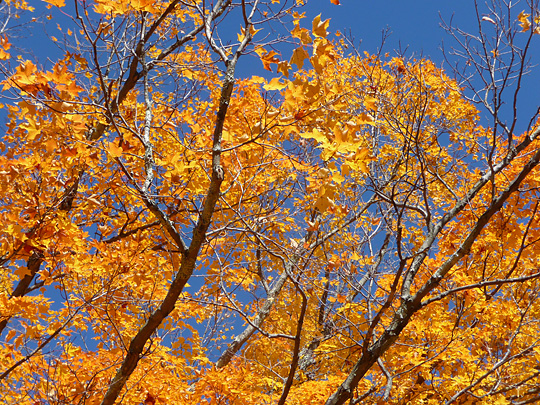
In this blog post, I would like to share some photos with you of what autumn looks like in New Hampshire. With the heat of summer behind us and the promise of snow this winter, we are sandwiched between the seasons until the first snowfall, usually in November. Come along on our walk to one of our favorite destinations:  Maple Grove Cemetery in West Concord, NH. In the fall, the Maple trees come alive with color as you shall see. This October day was no exception.

Yellow and Orange colors predominate in the cemetery

This old cemetery has a variety of old stones, some with inscriptions that are barely visible now

Fallen Maple Leaves on a windy day

A view of the sky through Maple leaves on this wondrous and clear day!


Wednesday, September 21, 2016

NH Coverlet Maker to be Honored

New Hampshire coverlet maker, Hannah Leathers Wilson, (1787-1869) will be honored posthumously this month by the National Museum of the American Coverlet in Bedford, Pennsylvania. She is being called the "celebrated weaver of the year." During her lifetime, that little-known weaver from Farmington, NH (and later, Tuftonboro, NH) made 184 coverlets. The whereabouts of 27 of her blue and white coverlets is known but the remaining 157 are yet to be found. Eight more coverlets have come to light since Donna-Belle Garvin, her primary researcher, presented a paper revealing Wilson's identity at the 1996 Dublin Seminar for New England Folklife. Before Garvin began to weave clues together, the coverlet maker's identity was unknown.

Example of a coverlet made by Hannah Leathers Wilson, courtesy of Donna-Belle Garvin, NH Historical Society


Wilson's coverlets have been collected by the Shelburne, Smithsonian, Old Sturbridge Village, and Henry Ford Museums, as well as the New Hampshire Historical Society, and the Royal Ontario Museum in Canada.

For more information, please see "Mystery Weaver Uncovered," a file set up some years ago at my website but re-posted to this blog on August 12, 2018:
http://quiltsandmusings.blogspot.com/2018/08/mystery-weaver-uncovered.html

Many thanks to Donna-Belle Garvin for providing the information and updates for this news release.


Tuesday, August 2, 2016

Happiness: An Essay

Happiness: An Essay

Patricia L. Cummings

Quilters are a happy bunch of people. They have discovered that work is fun! As an active quilter, I have found personal satisfaction while in the midst of the project. Yes, it is work, and on certain days I take out more stitches than I put in.

When the quilt is done, I look at it with a critical eye. Sometimes, in retrospect, I second guess my choices of pattern, colors, designs, or finishing techniques. The best part is that there is always the next time, the next chance to make that elusive "perfect quilt." Strangely, I do not care as much about the finished project as I do about the process.

The life of the quilt for me is when it is a newly-formed image in my brain. The anticipation of a new project is exhilarating and exciting. Oh, the expectations that come into play at that time! Then, as work progresses, the colors and design start to take on a life of their own. Lovingly crafted, stitches are placed to keep the layers of the quilt together for many years to come.

Being a quilter brings me much satisfaction. The attainment of happiness is a natural outcome of creativity. Happiness is not as elusive as most folks would have you believe. The most important key to having a happy life is deciding to be a happy person. Yes, this is a conscious choice and is something that each of us can choose daily when we realize that happiness is a matter of having a good attitude.

Part of that is to develop a habit of gratitude for the people in our lives. Make it a practice to thank others for the work they have done that has improved your own quality of life. This will help to improve not only their dispositions, but yours, as well. When you consider doing this you will find a large number of people who are helpful to you and who would appreciate a smile or a word of kindness. Only a minute is needed but your goodwill could help someone to feel happy and appreciated.

We get tossed about by the winds of chance, like quilts blowing in the breeze and as composites of biological parts, we are sometimes patched back together, just like an old quilt. The sun burns our bodies, even as the sun fades the cloth of our quilts. Time has a way of changing us permanently and forever. In the greater scheme of the universe, we and quilts are but a blip on the radar. At age 50, we begin to have a strong sense of our own mortality.

An "antique quilt" is one that usually 100 years old or at least more than 50 years old. At 50, are we antiques also?  That magical year is a turning point for most people. Youth is behind but we are not quite ready for the rocking chair. A Mary Chapin Carpenter song says, "Come grow old with me /... the best is yet to be." Aging gracefully and happily is a matter of choice.

I never cease to be impressed by my associations with friends in their 80s and 90s. From my personal observations, aging adults who are the most active are the happiest. Actively engaging the mind or the needle seems to go a long way toward continued personal happiness and fulfillment and sometimes even helps to maintain physical health. Meaningful tasks help to create an atmosphere where one can learn and grow at any age. As for me, I plan to die with a needle in my hand, or my nose in a book!

The main thing to keep in mind as one goes through life is to "Get the big picture," just as they instructed in Driver Training School. Look to what is ahead of you, but do not forget what is on the sidelines or what is coming from behind.

The past is in the past and we cannot change it. No matter how long it gets beaten, the dead dog will not walk again. As much as we think about or agonize over the past, we do not get a second chance at re-taping it. 

There is a refrain that says, "There is sufficient trouble unto the day." We may strive to change our present circumstances such as where we live, how much income we have, and what long terms changes we can achieve for our health. The most important thing to remember is that we can live more happily every day just by being more pleasant and by having as positive an attitude as we can muster.

Everything good in our lives starts with a "can do" attitude. Instead of saying we can't swim, perhaps it is time to jump into the water straight-away.  "Can't" is one of my least favorite four letter words. It speaks of defeatism. It makes one seem to be at the mercy of circumstance. Taking charge of our lives, on the other hand, makes us stronger as we go.

If you refuse to try, then you are defeated before you start. The more we do, the more we can do. The more capable we are at doing something, the more recognition we will get from others. The more recognition we get, the more positive we will feel about our work and ourselves.

The more positive we feel, the more self esteem we will have, and the more we will be able to reach out to others. The more we reach out, the more friends we will make. The more friends we have, the more connected we will feel and the more we will accomplish. This is the stuff that makes for happiness. The more you give, the more you will get in return, in tangible and non-tangible ways.
We are called to an abundant life and attitude is the key to its access. True happiness is home grown. It has nothing to do with how big a car one drives, whether one has maid service, a Cuisinart, or scrimshaw. It has to do with attitude. Part of the attitude should be a sense of thankfulness for everything and everyone good in our lives.

The flowers that bloom in your neighbor's yard, a friendly person at the Post Office, a call from a friend, all of these are things for which to be thankful and to treasure. In valuing and noticing the little things of everyday life, and being grateful for them - therein lies a measure of true happiness. Live in the moment and do not let preoccupation with yesterday's woes, or worry about tomorrow's potential problems, distract you from appreciating what is good about today.

Personally, I love the details of life. I like making quilts that take a lot of time and care. I enjoy paperwork. I like observing insects. They are the most fascinating little creatures. I love to watch birds and observe their behaviors. The change of seasons in New England is also a constant marvel, especially when God's paintbrush changes the many shades of green to rust, orange, yellow, red, and brown. With so much to see and so many wondrous things to get involved in, it seems tragic that so many people seem to go through life oblivious to the magic of it all.

Most "good" things in life are a result of concentrated effort on someone's part.  When my husband bakes bread, I appreciate it. I know how to bake bread, and do not do so as often as I would like. But when he takes the time to do that, I know from experience what an investment of time it is, and I value his efforts all the more.

He is an excellent cook who does the grocery shopping on his own some of the time, and who plans and prepares nutritious, wholesome, and economical meals. When I cook and bake, he is sure to tell me how much he appreciates that. In fact, when people ask why my husband and I are so happy, it is hard for us to figure out such a question. Our lifestyle works because of our dedication to do whatever is necessary to achieve shared goals.

We can all celebrate life on a daily basis by the things we choose to do.  For us, our hobbies of quilting and needlework, writing, reading, gardening, cooking, woodworking, and the study of art are our main interests. Surprisingly, I even enjoy housework, mainly because I like to have a clean house. I am just thankful to have a house. Maintaining a cheerful attitude toward work is why we are happy. When done prayerfully, it can assume a spiritual quality.

After the chores are finished,  then we feel that we have earned the right to relax and engage in more favored activities. Listening to music while cleaning passes the time more quickly and can be enervating. Watching the birds while doing the dishes by hand (we do not want an electric dishwasher), makes that task a pleasure. We are also not locked into stereotypical role models of men's work v. women's work. We are a team. Customarily, I go out to the flower garden to pull weeds, and Jim is as likely as not to grab a dish towel to help dry dishes.

A life lived in service to others can go a long way toward developing happiness. To feel useful is important to our mental health. Life is good!  There is always something new and wonderful waiting to be discovered.

As a quilter, it is comforting to know that it will not be possible to make every quilt pattern ever created, in my lifetime. I am absolved from even having to try to do that. However, it is wonderful to realize that there are limitless opportunities for re-creating old designs, as well as creating our own. We make our own blessings, minute by minute, and stitch by stitch.  Savor those minutes and those stitches.

Choose happiness. Engage yourself in creating an heirloom, whether it be a line drawing, a piece of poetry, or a handmade quilt. Doing so will give you a sense of well-being. You will experience the joy of being creative and your efforts are destined to make you or someone else smile in the future. We are called to be nothing less than happy people.

Happiness is when:

1)  you realize that you have enough love, enough talent, and
     enough money
2)  you are able to share your love with others by giving your
      time, your talents, and material goods
3)  you realize that your time here is limited and as a result
     of that, you live each day fully, gratefully, and joyfully
4)  you follow your dreams, even if it means casting off the
      nay-sayers and negative thinkers in your life
 5)  you make time for you:  to play, to think, to pray,
      and to create.
 6)  and finally, happiness is passing it on.


©Copyright 2002. Patricia Cummings, Quilter's Muse Publications, Concord, New Hampshire

Saturday, July 30, 2016

Billings Farm & Museum Opens New Quilt Exhibit

Billings Farm & Museum, Woodstock, Vermont, has opened its 30th Annual Quilt Exhibition of contemporary quilts by quilters of Windsor County, Vermont, and challenge quilts by the Delectable Mountain Quilters. The quilts will be on display until September 18, 2016.

There is a lot to like about this relatively small quilt show. Many woman-hours went into creating all of the quilts on display and what a variety of quilts there are! One can re-visit traditional patterns such as Sunbonnet Sue, Storm at Sea, and Spider Web, but all with a modern twist! The signage with each quilt is outstanding, telling the history of the pattern or the reason why the quilt came to be, reminding me of the late Helen Kelly's comment that "Every quilt has a story!"

"Storm at Sea," a traditional quilt pattern with a twist. Made by Charlotte Croft

Many of the quilts were made to give to a friend, donate as a charity fundraiser, or to give to a family member. In the case of "Storm at Sea," Charlotte Croft added two heart-shaped leis to a traditional pattern. She plans to give the quilt as a wedding present to a grandson who was born in Hawaii two weeks before Hurricane Iniki hit. The quilt honors his place of birth.

We loved a wolf-themed large bed quilt made for friends. We really liked a quilt that is a tribute to the medical profession which has fabric that features "tools of the trade." From a 9,009 piece Bargello quilt in bright colors, to a small wall quilt with depictions of birds, to a salute to the Civil War via a quilt that combines two patterns of antique Sanitary Commission quilts, the show has something for everyone. This year the challenge quilt section was devoted to quilts with at least two stars.

For the price of admission to the museum, one can see much more than quilts. Learn more about Billings Farm & Museum by visiting their Facebook page and/or going to their website. We have enjoyed being invited to preview their quilt show for many years now, ever since I wrote an article for The Quilter magazine about the place (which may still be featured on their website),  and also gave a special presentation there about Redwork embroidery one year. Woodstock, Vermont is a great destination and Billings Farm & Museum is its crown jewel!

Patricia L. Cummings

Tuesday, July 12, 2016

The Poore Family Homestead Historic Farm Museum

This evening I was delighted to see a segment on NH Chronicle (local TV programming) about the Poore Farm Museum in Stewartstown, New Hampshire which is near the Canadian border. In December 2013/January 2014, an article I wrote about the place appeared on the pages of The Quilter magazine. One can read that article, in its entirety, by visiting www.poorefarm.org and scrolling down to "News" and clicking on that link.

The article centers on the history of the farm that held by the same family for more than 150 years. Of course, the article features the textiles and quilts we saw in the house.

I shall reprint one paragraph to give you a glimpse of the article:

     Upon entering the house, one feels as though the inhabitant has just stepped out and will return shortly. Kenneth slept in the same bed in which he was born. He managed to live for almost a century with no electricity, no central heating, and no running water. Dairy products and meat were kept cold by immersion in cold mountain water, carried to the house into a spring box by wooden pipes made from hollowed-out logs joined with pitch. The water was diverted into a cast-iron bin that sits in a small room right near the kitchen.

As usual with treks to museums, we learned a lot during our visit. Be sure to visit the Poore Farm Museum's site to learn more about this fascinating place! Better yet, go in person if you are in the area!

Patricia Cummings


Sunday, July 10, 2016

Birthday Quilt

A most extraordinary quilt was sent to me for my birthday this year. A dear friend mailed me an appliquéd quilt that was designed by Becky Goldsmith of Piece o' Cake Designs. Becky calls the botanically-themed quilt "Simply Delicious." It is based on her Block of the Month offer which is still available on her website. The quilt was won at an auction to benefit St. Jude's Children's Hospital about 12 years ago. The quilter is "Anonymous."

Gift quilt - how sweet it is!


I shall soon be making a label for the back of the quilt to document its size and other details as I know them to be. The quilt arrived with the number 2386 written on an attached tag. Of 20,000 quilts donated to the hospital, only 20 of them were selected for auction that year (2004) and this is one of them. The quilt could be a large wall quilt, if one had the space, or would fit a twin size bed. The designer noted that the quilter made some modifications in the size of the sashings and outer border to increase the overall size of the quilt.

It is not every day that one receives such a beautiful gift of friendship! The appliqué work is exquisite and precise. I also love the quilter's choice of fabrics. The pieced backgrounds and sashings do not overwhelm the blocks as the colors used are subtle. Everything seems perfect, even the machine-quilting! I feel very lucky, indeed, to have been given such an unexpected treasure. The only thing that would increase my joy would be to find out who made this quilt. I love to give credit where it is due! In the meantime, I shall continue to admire the fine workmanship. The quilt lives up to its name. It is "Simply Delicious"!

Monday, May 30, 2016

What Quilter Does Not Love Flowers?

After the rain, the chives are in full bloom all ready for bumblebees!

The daisies are loving the good mix of sun and rain we have been having in New Hampshire

This Rugosa rose is sometimes called "Beach Rose" as they are often seen at the beach

First Siberian Iris of the season with more buds to open soon

What is a garden without a toad? They are very beneficial to the eco-system!

Just in time for Memorial Day - our Poppies are blooming!

Rugosa roses can be seen in white, as well as pink


Monday, May 9, 2016

Quilt Show at Belchertown, Massachusetts

Learning of another quilt show this year at the United Church of Christ Congregational Church in Belchertown, Massachusetts, we made plans to attend inasmuch as we enjoyed last year's show so much. In this blog, we will show you three photos to give you a taste of the show.

The theme of the show was "Hexagon Quilts," both old and new.

"Stolen Moments" close-up; quilt by Jane Crutchfield

Altar display features two Grandmother Flower Garden quilts by Judi Wilson and Virginia DeSantis. In the foreground is a brightly-colored polyester vintage quilt, and a Dime Size hexagon quilt by Lara Kline

To the left hangs a 1930s Diamond Hexagon quilt by Adrianne Duquette. To the right is "Stolen Moments," a modern quilt in the same style by Jane Crutchfield


There were two quilts that really stood out and are quite memorable. The first is a polyester quilt made of brightly-colored hexagons. The quilt was found to purchase in Ohio and features both solid colors and prints (one a cat). This was placed on a frame at the front of the church in the altar area display.

On the stage are two large Grandmother's Flower Garden quilts made by Judi Wilson, and Virginia DeSantis. A Dime Size Hexagon quilt was made by Lara Kline.

To the left of that display area hang two quilts, one an antique diamond hexagon made in the 1930s by Adrianne Duquette. To the right is a new quilt in the exact same style and with the exact size of hexagons used. The maker, Jane Crutchfield, calls it "Stolen Moments" and it is a quilt in progress done all by hand. I loved standing in front of it, looking at all of the conversational prints she uses in the center of each diamond block. It is an amazing piece of work! In unwrapping Duquette's quilt while hanging quilts in the show, Crutchfield was stunned to see the similarities between that vintage quilt and her own.

In the show, there is another bed-size quilt made by Crutchfield that is all half-hexagons, equally amazing (not shown). Of course, there were many other quilts in this most enjoyable show! In addition, piles of fabric, thread, yarn, and many, many quilt books were offered in exchange of a donation of one's choosing.

The show's theme next year will be "Bow Tie Quilts." If you are in the area, don't miss it next May!

Patricia L. Cummings
http://www.quiltersmuse.com


Wednesday, May 4, 2016

Civil War Activity Cited

The Concord Insider is a free, local newspaper in Concord, New Hampshire that carries a column which highlights happenings of the past. While reading a recent edition, I spotted this former yesteryear news entry related to textiles:

April 22, 1861: Meeting at the South Congregational Church, a group of Concord women organizes an effort to supply soldiers with "articles necessary to their comfort in the field." They have raised $200 and resolve to spend $150 on flannel for shirts for the First New Hampshire Volunteer Infantry Regiment.

Throughout the Union states, during the U.S. Civil War, women gathered in small groups to knit socks for soldiers, make quilts for the U.S. Sanitary Commission to distribute to soldiers, and gather other useful items to send by post. Any mail, including letters from the homefront, was most welcome by the troops. Whether working at home alone or in a group, the women's efforts were voluntary. They were doing all they could to support loved ones and others on the field of battle.


Monday, May 2, 2016

Ellen Webster Mention in Ephemera

Yesterday when I was reading Sue Wildemuth's blog: http://sew-eyeoftheneedlequilthistory.blogspot.com, I came across a mention of Mrs. Ellen E. Webster, the woman about whom I wrote such a lengthy e-book in 2008. Ellen was a quilt historian and quilt judge (among many other titles she held). She was friends with Florence LaGanke Harris who in this case served as a co-judge in the 1933 contest, as noted by a quote from Farm Journal magazine. The third judge that year at Storrowton, was Mary Ross Reynolds. I learned that the quilt contest of 1933 was the Second National Patchwork Quilt Contest conducted by Eastern States Exposition (in Storrowton). I do not know if Mrs. Webster was a judge during the first contest held by them.

For fun, I looked through my own book today and perused diary entries that I had excerpted from Mrs. Webster's 5-year diaries. On August 21, 1933, she says that she "went to Storrowton, Mass. to serve as a judge on the Quilt Exhibit."

On August 23, 1933 she notes, "Worked all day on quilts and came to decisions on prizes for the antique quilts." (She was judging antique quilts sent in from all over the country).

On August 24, 1933 she says, "Decided on prizes for the modern quilts and Mrs. Harris did part of the writing up of the notes for each prize winner."

On September 8, 1935 she mentions, "Mrs. ____(illegible) met me at the station and went with me to Storrowton where I am to serve as Chairman of Judges. The quilt exhibit of about 400 entries."

Again, it seems that she may have served as a quilt judge the next year. On September 13, 1936 she says, "Worked desperately to finish packing for Storrowton.

I was thrilled, of course, to see Mrs. Ellen E. Webster's name in print in one of the Farm Journal magazines.

This is the CD cover of my e-book. The book is for sale. The price is $24.95 plus $3.00 shipping. Please contact me at quiltersmuse@gmail.com for further information!