Hmong Needlework Traditions
Patricia L. Cummings
Had it not been for the friendship between the Hmong (pronounced “mung”) of Laos and the United States military during the Vietnam War, most Americans would be unaware of the rich textile traditions of these brave and gentle people. Hmong contributions to the war effort were immense. They intercepted Vietcong supplies along the Ho Chi Minh Trail, rescued downed U.S. helicopter pilots, were the eyes and ears of the Central Intelligence Agency, and worked as foot soldiers.
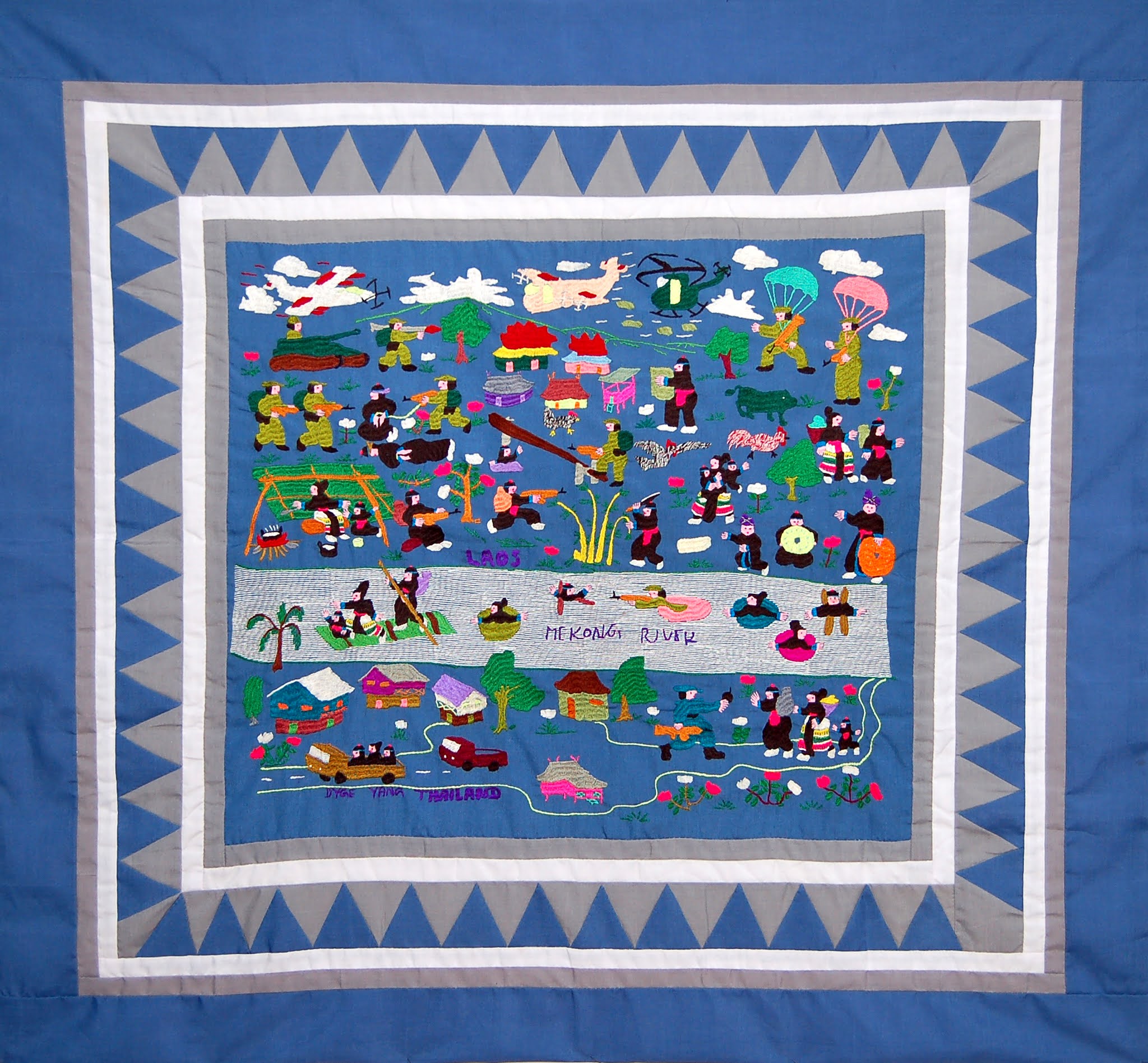
When the U.S. exited Vietnam in 1975, the Hmong people were at the mercy of the Communist victors, who were intent on retaliation. Ultimately, they fled across the Mekong River to reach the safe shores of Thailand. Half of the Lao Hmong population, about 230,000 people, were sheltered at United Nations refugee camps, where they were held until cleared to move on to another country. With little to do in the camps, both men and women passed the time by making embroidered Paj Ntaub (Hmong stitchery). These “story cloths,” containing motifs of animals, crops, and people, show what village life had been like and how it had drastically changed.
Story Cloths
Story cloths consist of two layers and often include embroidered images of pigs, chickens, goats, horses, cows, and water buffalo, which the Hmong customarily kept when they were hillside farmers. The detailed embroidered village scenes feature people at work – many with baskets on their backs – cultivating corn, weaving, or pounding dry-land rice. Women often carried their babies into the field using colorful papoose-like carriers with straps. The babies would wear special, embroidered hats to keep evil spirits away. The colorful huts and overall activity present a tranquil view of life in Laos.

When the Hmong men picked up a needle, a different story was told – that of Communist soldiers with guns terrorizing innocent civilians, while helicopters and planes drop mycotoxins that some called “Yellow Rain.” The lethal manmade concoction was repeatedly dropped on Hmong villages, causing severe illness and death. The story cloths of men show attempts to escape across the Mekong River. These included depictions of bamboo sticks to which they clung, rafts, tires, inflated plastic bags and occasionally boats (if they paid someone). Many drowned because they did not know how to swim. These story cloths serve to instruct future generations as to what actually happened and why it was important to seek asylum elsewhere.
Pa Ndau Applique
In addition to story cloths, the Hmong make “flower cloths,” needlework designs called pa Ndau (pronounced “pond-ouw). To make a flower cloth, three layers of cloth are required. The fabric is marked, cut away, turned under, and appliqued down with tiny stitches. Of the geometric designs most common is the “Elephant’s Foot” motif.

Another common design is “Snail House” which symbolizes the (important) extended family. “Dragon’s Tail” is a version of a “Snail House” design. Star designs and heart designs are also common. Pa Ndau is often embellished with additional small designs and embroidery.
Needlework Traditions
Mothers begin to teach their children needlework from as young an age as three and the embroideries create an important connection for mother and daughter. Ia Moua Yang, in her booklet, The Pa Ndau of Ia Moua Yang: Keeping Alive the Treasure of the Hmong, touchingly observes, “As the mother gets older, she and her daughter make a very special Pa Ndau for a gift exchange so when they get to the spirit world, they will be able to meet each other again.”
Included in every Hmong girl’s dowry are special burial cloths that are given to her when she leaves home. Funeral celebrations are very important to the Hmong. New Year’s celebrations are also a time to show off Hmong-embroidered clothing and to compete for the “best of show.”
Besides story cloths and flower cloths, the Hmong make a variety of embroidered objects, including cross-stitched belts, purses. holiday ornaments and many other small textiles. Their needlework has become a means of revenue.
New Beginnings
Since the end of the Vietnam War, the Hmong people who came to the U.S. have had some time to become acclimated. There is no doubt that their culture is changing, an inevitable result of being exposed to a much different way of life. There is also a danger that Hmong needlework traditions will not be a priority with the younger generations. The skills may stand as an endangered species, just as the tigers they left behind.
About the Author
Patricia L. Cummings had her own column, “Pieces of the Past” in The Quilter magazine for 15 years. She is certified by the Embroiderer’s Guild of America as a master craftsman in quilt making. James Cummings serves as the photographer for all of Pat’s books and articles.


