Translate

Thursday, July 22, 2021

Billings Farm & Museum's Quilt Exhibition 2021

Contemporary Quilts made by Windsor County Quilters and Challenge Quilts by the Heart of the Land Quilt Guild are featured in the 35th Annual Quilt Exhibition at Billings Farm & Museum in Woodstock, Vermont. The display is open daily from July 17 - August 22, 2021.

Here are just a few of the quilts that currently hang in the exhibit.

"Farm Friends" made by Lynne Weatherill is machine-pieced, paper-pieced, hand-quilted, and tied. It is her first paper-piecing project and she found it challenging at first. There are as many as 57 pieces in just one animal.


"Berkeley" by Linda Diak is appliqued and machine-quilted. It is a portrait of a Berkshire pig and is based on a photo posted to the Billings Farm & Museum website. Berkeley is no longer "on the planet" but he lives on in memory. The quilter was able to use supplies she had on hand during the pandemic to create this quilt.


"Timeless Ties" by Sue Cass is a memory quilt made to honor the deceased husband of her friend, Patricia. Seventy ties were used in its creation. The quilter chose to make Dresden Plate and Fan blocks and used leftover scraps of ties to create the borders. The quilt is machine-pieced, appliqued and machine quilted.


As always, we enjoyed seeing the fine work of Windsor County quilters! There is always a lot of variety in this show. We especially liked the farm-related quilts this year and we like quilts that come with a "story." 

The Billings Farm & Museum  is located at 69 Old River Road in Woodstock, Vermont and is well worth the trip. Check out their website at www.billingsfarm.org


Thursday, July 15, 2021

Christmas in July

With sweltering temperatures outside, my thoughts turn to ice cream and Christmas, maybe not in that order. I am thinking of a quilt I made in 2014. It features a Redwork embroidery motif of birds and holly. The design is a very enlarged version of a line drawing that was published in the Cunnings catalog, a late 19th century catalog from which one could order designs for outline stitch embroidery (another name for Redwork). The catalog features thousands of designs or so it seems! There are many monograms, flowers, owls, Japanese-themed motifs and other designs.


Anyhow, this particular image of birds appealed to me, being a bird-lover and all. I enjoyed hand-quilting this quilt. Anything to help me dwell on the delights of cooler weather and the coziness that Christmas holidays bring when it is snowing outside and we do not have to go anywhere. At that time, it is fun to listen to Christmas music and do some quilting in the den. As humans, we always want something else. In winter, we long for summer but when summer arrives, it is often overrated because of torrential rains, thunderstorms, and high temperatures. For now, I am dreaming of Old Man Winter visiting again as Jack Frost coats our windowpanes in frosty designs!


Monday, June 7, 2021

Quilt Finished

 The "Woodland Creatures" quilt that I designed is now finished. I asked Janet-Lee Santeusanio of Woodland Manor Quilting in Hampton Falls, NH to machine-quilt it for me. I think she did an outstanding job! This is a just-for-fun quilt. I chose Hobbs 80/20 batting. Here are some photos.


Tuesday, May 18, 2021

New Exhibit to Feature Sweetheart Pillows

 According to the Wright Museum of World War II's website, that Wolfeboro, New Hampshire museum will feature a special exhibit from August 17 to October 31, 2021 which will include sweetheart pillows from World War II. "Shaped by Conflict: Mementos of the WWII Era" is a much anticipated exhibit that was supposed to have been presented last year but was postponed a year due to the pandemic.


For those of you who are unfamiliar with these once ubiquitous textiles, sweetheart pillows and mother pillows were commercially-produced during World War II and were mostly rayon or acetate, except for those silk-screened pillow covers made during World War I (also featured in my book).  I donated the World War I pillow covers to the National World War I Museum & Memorial. 

In 2018, I donated all of the pillow covers and other related WWII textiles I had collected to the Wright Museum as the Patricia Cummings/Lyell D. Henry, Ph.D. collection. When I was writing the landmark book Sweetheart & Mother Pillows, published by Schiffer Publishing in 2011, Dr. Henry sent me 103 of the pillow covers he had collected over a 40 year span. To those, I added the many pillow covers I acquired which, in all, amount to a hefty collection! Included is a quilt made of pillow covers; and a silk pilot's map of China, as well as other small assorted items. I enjoyed the two humorous ones I collected the most!

I thoroughly enjoyed the research I did on these textiles and my book is the first and only one so far published on this topic. Included is a chapter about the Civilian Conservation Camps, the C.C.C. Pillow covers were available for the recruits to purchase and send home and I found some dandy ones to show in the book. I have since donated all of those pillow covers to the C.C.C. Legacy Foundation.

Mark your calendars now. You won't want to miss this exhibit, if it is possible for you to attend. The museum closes on October 31 so the display will be up until that date.

Saturday, May 8, 2021

Woodland Creatures Quilt

 I have just completed a quilt top that I am calling "Woodland Creatures." Each hexagon in the hexagon rosettes is fussy-cut and represent various animals. There are bunnies, deer, bears, owls, chickadees, hedgehogs, etc.  In person, the quilt is very colorful!


The hexagon rosettes are appliqued onto various brown print fabrics. The alternate blocks are pink fabrics that I had in my "stash." The border is a batik brown print. I really enjoyed putting this quilt top together. I planned it as I went along. I kind of outsmarted myself. Initially, I cut the brown blocks at 8" square. By the time I had appliqued on the hexagon rosettes, I needed to square up the blocks to measure 7 1/4" which leaves me with blocks that are 6 3/4" square when sewn into the quilt. I have always enjoyed seeing quilts that have a combination of brown and pink squares. I'll be happy to put on the binding and label, once I get it back from the machine quilter. This "snuggle" quilt measures 58" long x 45" wide.

Patricia Cummings


Thursday, April 15, 2021

Quilt History

 The history of quilts is a fascinating one. The University of Nebraska-Lincoln graduate class "History of Quilts" that I participated in when the class was newly-minted just touched the surface of the topic. The American Quilt Study Group with its publications "Blanket Statements" and its annual journal "Uncoverings" is constantly expanding our awareness of the subject of quilt history, in general, and it also highlights individual quilts and quiltmakers. State project books, of which there are many, further elucidate the study of quilt history. And, individual museums, such as the Metropolitan Museum of Art and Colonial Williamsburg have published their own books to show off their quilt collections.

I have been studying quilt history for years now and there is always more to learn. Quilt collectors share information about their quilts which adds to a greater understanding. Online, the Quilt Index shows quilts as does the International Quilt Study Center. Sometimes new information trumps older information which needs to be updated. There are those who study and try to keep up with current data and there are those individuals who may base their information on one source that is not reliable.

Myths have circulated about quilting. These "stories" which are nothing more than "feel good" attempts are spread by well-meaning but deluded people. Before sharing information of a historical nature, it is best to document it using multiple sources.

One of the two biggest myths that I have taken on in the past is twofold: the story that slaves used quilts as signal devices on the Underground Railroad and that quilts were hung on clotheslines to denote "safe houses" for slaves. Both theories have been discounted as not plausible and with no evidence to support either one.

The second myth that comes to mind is the mistaken name of Ellen Emeline Hardy Webster about whom I wrote an extensive e-book in 2008. A previous researcher thought her name was Emily Webster. In my book, I describe the association between Ellen Webster and her non-related friend, Emily. Once a statement is in print, it is hard to rectify an error as people will continue to seek out source material and sometimes seize on the first reference they find, not looking any further, which is why multiple references are always a good idea. I gathered "proof" and know for certain Ellen's true name. She was a wonderful teacher, researcher, quilt chart maker and deserves to be known by her actual name.

New quilt discoveries and connections are being made all the time. It's an exciting time to be involved with quilt history. For those who are interested, I urge you to read all that you can and try to get the "big" picture of when quilting started, the many examples of types of quilts made for various purposes, the years when quilting was most popular, and so much more! It is a rich field! 

For those of you who are interested in block history, there is a new book out, actually the 3rd edition of The Encyclopedia of Pieced Patterns by Barbara Brackman. Color has been added to this volume and more blocks than the 2nd edition. To accompany the book, there is a software program that can be purchased separately called Blockbase+. This program is useful for printing out templates for blocks of various sizes.

There is always more to discover. Happy Quilting!

Patricia L. Cummings


Thursday, April 8, 2021

Knitting: The New Craze

 Crafts seem to come and go in phases. During the 1960s Crewel Embroidery was "big." Then came a wave of Counted Cross Stitch and Needlepoint. I have works in all of those mediums. Then, in 1985, I made my first quilt and was "hooked." I wanted to know anything and everything about quilting and I tried many techniques. At first, machine quilting as it is practiced today by longarm quilters was a new thing. Most people who quilted in the 1970s and beyond were actually making comforters for not a quilting stitch by hand was in sight except by those who had learned the art of quilting from their mothers or grandmothers.

I made hundreds of quilts in all sizes ranging from miniature to queen size. I'll admit that many of the bed quilts were tied to secure the three layers together, not quilted by hand or by machine. As time went on, I took on a few large hand quilting projects (quilts) that took me a year each to quilt (like the Calico Garden quilt hanging on the wall in the photo below). Lately though, I have succumbed to the ease of having quilts quilted by a longarm artist. There is something gratifying, after all, in having a project finished and not hanging around as an unfinished object.


Today, the latest trend in "crafting" seems to be knitting. I belong to one circle of knitters. I find that I need to choose projects in which I don't have to think or count because I am too distracted when people start talking. So, I have taken to making winter scarves for needy children. I donate them to the Retired Senior Volunteer Program at the local Friends organization and they distribute them. Since March 2020, when the pandemic set in, I have made six scarves to donate. I use the knit stitch only for the scarves and leave the ends without fringe, per the organization's request. Fringe can get caught in zippers.

It seems that others, including some famous people, have taken up knitting, too. I learned to knit when I was about 12 years old through 4-H, about the same time I was taking 4-H sewing lessons. My mother neither sewed nor knew how to knit. I managed to make some sweaters for myself and family members but I did not knit for many years. I was too busy participating in the master craftsman program for quilt making and completed that certification in the year 2000 (after 9 long years of submitting projects to be judged).

As a quilt historian now, I find the field to be very rich with information. There are less details available about the history of knitting but I did find one book with some interesting facts about the topic. I shall have to sit down with that book soon and enjoy learning what I can from it. 

For now, quilting projects have taken a back burner to my knitting. I am sure I shall make more quilts but this has been a nice interlude. I like to make useful articles that people can enjoy and it cheers me to think of "forgotten" children enjoying my colorful scarves and hats!


Thursday, November 12, 2020

Pilgrims Wall Quilt

 Some projects take a while and it is a good thing that I never throw out anything! In 1963 I embroidered the pilgrim woman and pilgrim man panels and not knowing what to do with them I set them aside. At that time, I was not a quilter. In 2013, I decided to finish them into a small wall quilt. Hope you enjoy seeing this project that was 50 years in the making! Happy Thanksgiving!


Saturday, October 17, 2020

Christmas Cactus

 Anyone who knows me knows that I love houseplants. I became interested in them as a 4-H project when I was about 12 years old and have kept some plants ever since. Right now, I have two very large Christmas cacti, (three to four feet in expanse), one with broad leaves and the other with smaller, more delicate leaves. The one with broad leaves blooms twice per year for several months. As it has gotten older, one side blooms at a time, quickly followed by the other side. I don't know why that is happening as I rotate the plants a quarter turn every time I water them.


The broad leaf cactus has a history. I started the plant using one segment that had fallen to the floor of my mother's nursing home room when a visitor brought a blooming plant to my mother's roommate. The segment was in very good condition and my mother told me to bring it home to see if I could "root" it. I did just that! The plant grew by leaps and bounds and has consistently rewarded me with many blossoms.

The last time it bloomed was in May. Now it is October and it has begun blossoming again. I expect it will "go" until Christmas, if not beyond.

My other plants are succulents and African violets. I have one orchid that was given to me and when it finished blooming, it has put on more growth but no more buds. I have it under a grow light along with some of the African violets. When it comes to plants, I find it is best to water them once a week, fertilize them occasionally, and just let Nature do its thing. They are so cheerful and an added benefit is that they add oxygen to the air! They respond to Tender Loving Care and they never talk back!


Wednesday, September 23, 2020

The "Mayflower Quilt"

 The “Mayflower” Quilt

Patricia L. Cummings

The Oldest Known Wholecloth Quilt Brought to America

Perhaps the earliest known quilt found in North American museum collections is one that at one time was dubiously called, “The Mayflower Quilt.” Described as being made of linen, the wholecloth quilt was carried aboard the “Angel Gabriel” galleon by the Cogswell family.  Members of the family included John Cogswell (43) and his wife, Elizabeth (41), and 7 children: William (18), Mary (16), John Jr. (13), Hannah (11), Abigail (9), Edward, (6), Sarah (3), and Elizabeth, (an infant). They hailed from Westbury Leigh, Wiltshire, England and the “Angel Gabriel” departed from Bristol, England in 1635.


Lovely Lane Museum, Baltimore, Maryland, now owns the quilt. Robert Shindle, Museum Director, noted in an e-mail to me that no facts have ever been found to support an association of the quilt with the “Mayflower,” a ship that brought passengers to Plymouth, Massachusetts in 1620.  

Indeed, no record can be found of this particular galleon ever being called “Mayflower.” Originally, it was called “Starne” and was built for Sir Walter Raleigh to carry him from England to South America. After his unsuccessful attempt to find gold in Spanish-held territory along the Orinoco River, he was beheaded. Later, the vessel acquired the name “Jason.” Records show that at one point, it served to transport cargo such as cotton, lead, and raisins to the New World. The galleon was renamed “Angel Gabriel” in mid-1619.

Museum Acquires Quilt

According to Shindle, the quilt was purchased from Mrs. Susan Litch Williams for $85 dollars by Reverend N.T. Whitaker on September 1897 on behalf of Rev. John Franklin Goucher, then President of the Woman’s College of Baltimore (later Goucher College). Then the quilt was given by Dr. Goucher’s daughters to a church, now known as Lovely Lane Methodist Church, when it was in the process of opening a museum in 1954. Rarely seen by the public, the quilt was published in a 2006 calendar previously offered for sale by the museum

More Information Found

The “Angel Gabriel,” a 240 ton galleon made of wood and sails, carried 25 or more passengers on its final voyage to New England, a trip that was part of the “Great Migration” of Puritans to the New World from 1620 to 1640.

On August 14, 1635, the ship was anchored near Pemiquid Point, Maine for the night. The passengers disembarked by rowboat, carrying enough gear to stay on dry land, including the quilt. At 6:30 a.m. the following day, ferocious winds caused by the “Great Colonial Hurricane of 1635” smashed the ship to smithereens and washed the shipwreck out to sea leaving only scattered floating debris on the surface of the water. The vessel was never seen again, in spite of continued and concerted attempts by searchers who continue to seek out any remains.

Angel Gabriel: The Elusive English Galleon / Its History and the Search for Its Remains by Warren Curtis Riess (Bristol, Maine: 1797 House, 2001), mentions the journal account of Reverend Richard Mather, written in 1635:  “[…] most of the cattle and other goods, with one seaman and three or four passengers, did also perish therein, besides two passengers that died by the way,” (“Richard Mather’s Journal,” Chronicles of the First Planters of the Colony of Massachusetts Bay from 1623-1636, ed., Alexander Young (Baltimore: Genealogical Publishing Co., 1846).

Galleon Survivors and Their Descendants

Today, a plaque mounted on a rock at Pemaquid Point, Maine is dedicated to the Cogswell family which later settled in Ipswich, Massachusetts. A similar plaque honors the memory of Ralph Blaisdell (42), his wife (age unknown), and their son, Henry (3) of Lancashire, England who later first went to York, Maine and later settled in Salisbury, Massachusetts. Family descendants of those shipwrecked still live in New England. 

One such person is Barbara Bean Stevens, a resident of Groton, New Hampshire. She is a direct descendant of John Burnham who at the age of 10 was allowed by his mother, Mary Andrews Burnham, to accompany his uncle, Robert Andrews, the captain of the “Angel Gabriel,” along with John’s two brothers, Thomas and Robert Burnham. In information written for the Groton Historical Society in their Winter Newsletter (Vol. IV, Issue 4, 2006), Stevens provided information to Louise Traunstein, Groton Historical Society Archivist and Newsletter Editor.

Stevens recounted she had read in several historical accounts that during the hurricane,  noted ships were lost at sea, ocean swells were over 20 feet high, and Indians (Native Americans) had to climb trees for safety. Hundreds of trees were uprooted and dwellings destroyed as gale force winds continued for five to six hours. Unlike the Cogswell family, the sea captain and his nephews escaped only with their lives and nothing else.

A treasured piece of the past, the “Mayflower Quilt” name evokes a time when Christian believers gathered up their most valuable possessions and ventured from their familiar surroundings to seek religious freedom in the New World. We are very lucky that this quilt was saved and has been preserved in a museum setting. It is an early example of a quilt from a time when quilters simply used needle and thread to work surface designs in pleasing patterns. Perhaps, though, it is time that the quilt was called, “The Angel Gabriel” quilt.

                                                                            ###

Patricia L. Cummings is a writer and quilter whose many articles have been published by The Quilter magazine and other publications. She writes books about Redwork embroidery, quilt history, and other topics. 

Monday, September 21, 2020

Hmong Needlework Traditions

 Hmong Needlework Traditions

Patricia L. Cummings

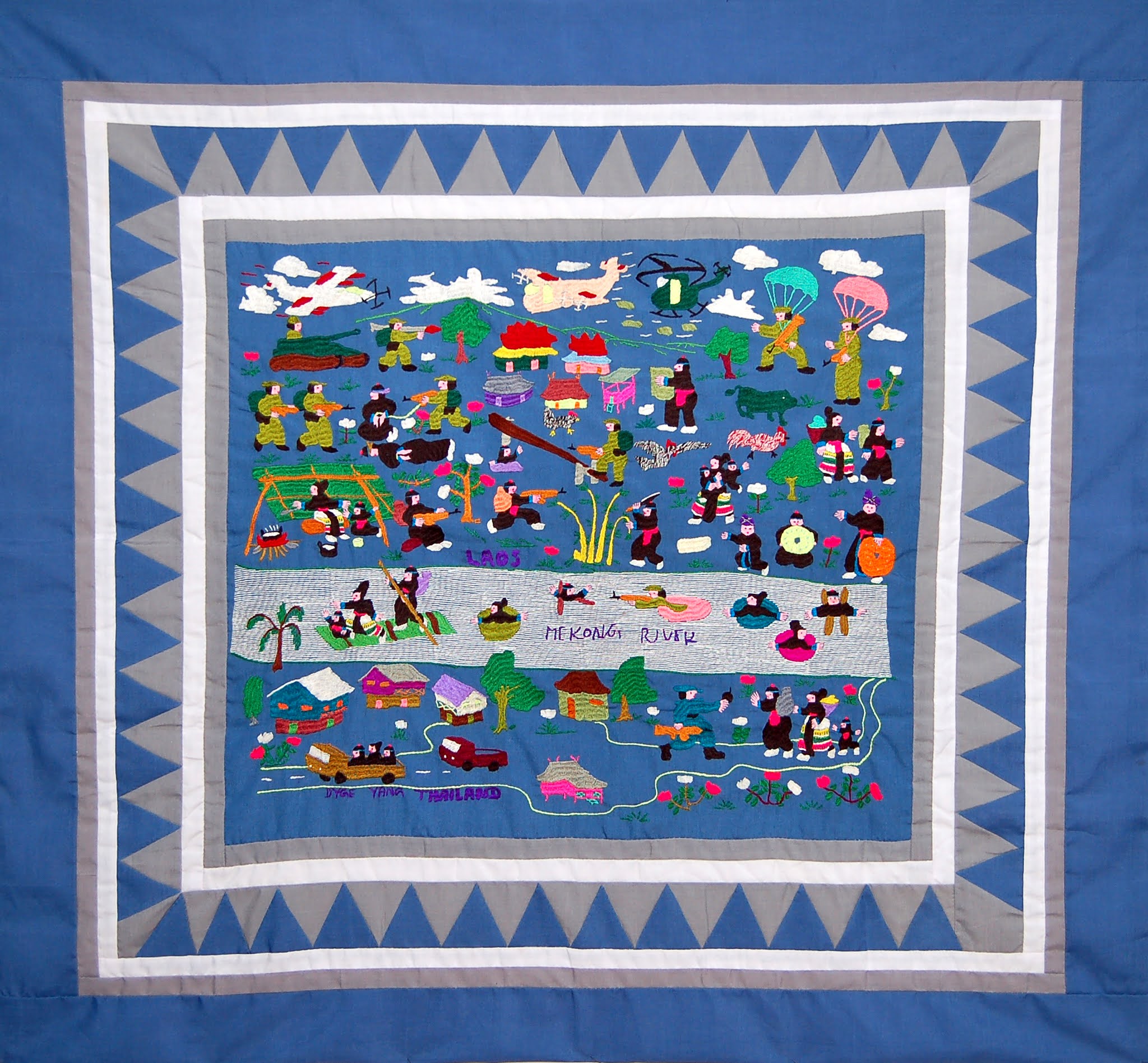
Had it not been for the friendship between the Hmong (pronounced “mung”) of Laos and the United States military during the Vietnam War, most Americans would be unaware of the rich textile traditions of these brave and gentle people. Hmong contributions to the war effort were immense. They intercepted Vietcong supplies along the Ho Chi Minh Trail, rescued downed U.S. helicopter pilots, were the eyes and ears of the Central Intelligence Agency, and worked as foot soldiers.


When the U.S. exited Vietnam in 1975, the Hmong people were at the mercy of the Communist victors, who were intent on retaliation. Ultimately, they fled across the Mekong River to reach the safe shores of Thailand. Half of the Lao Hmong population, about 230,000 people, were sheltered at United Nations refugee camps, where they were held until cleared to move on to another country. With little to do in the camps, both men and women passed the time by making embroidered Paj Ntaub (Hmong stitchery). These “story cloths,” containing motifs of animals, crops, and people, show what village life had been like and how it had drastically changed.

Story Cloths

Story cloths consist of two layers and often include embroidered images of pigs, chickens, goats, horses, cows, and water buffalo, which the Hmong customarily kept when they were hillside farmers. The detailed embroidered village scenes feature people at work – many with baskets on their backs – cultivating corn, weaving, or pounding dry-land rice. Women often carried their babies into the field using colorful papoose-like carriers with straps. The babies would wear special, embroidered hats to keep evil spirits away. The colorful huts and overall activity present a tranquil view of life in Laos.


When the Hmong men picked up a needle, a different story was told – that of Communist soldiers with guns terrorizing innocent civilians, while helicopters and planes drop mycotoxins that some called “Yellow Rain.” The lethal manmade concoction was repeatedly dropped on Hmong villages, causing severe illness and death. The story cloths of men show attempts to escape across the Mekong River. These included depictions of bamboo sticks to which they clung, rafts, tires, inflated plastic bags and occasionally boats (if they paid someone). Many drowned because they did not know how to swim. These story cloths serve to instruct future generations as to what actually happened and why it was important to seek asylum elsewhere.

Pa Ndau Applique

In addition to story cloths, the Hmong make “flower cloths,” needlework designs called pa Ndau (pronounced “pond-ouw).  To make a flower cloth, three layers of cloth are required. The fabric is marked, cut away, turned under, and appliqued down with tiny stitches. Of the geometric designs most common is the “Elephant’s Foot” motif.


 Another common design is “Snail House” which symbolizes the (important) extended family. “Dragon’s Tail” is a version of a “Snail House” design. Star designs and heart designs are also common.  Pa Ndau is often embellished with additional small designs and embroidery.

Needlework Traditions

Mothers begin to teach their children needlework from as young an age as three and the embroideries create an important connection for mother and daughter. Ia Moua Yang, in her booklet, The Pa Ndau of Ia Moua Yang: Keeping Alive the Treasure of the Hmong, touchingly observes, “As the mother gets older, she and her daughter make a very special Pa Ndau for a gift exchange so when they get to the spirit world, they will be able to meet each other again.”

Included in every Hmong girl’s dowry are special burial cloths that are given to her when she leaves home. Funeral celebrations are very important to the Hmong. New Year’s celebrations are also a time to show off Hmong-embroidered clothing and to compete for the “best of show.”

Besides story cloths and flower cloths, the Hmong make a variety of embroidered objects, including cross-stitched belts, purses. holiday ornaments and many other small textiles. Their needlework has become a means of revenue.

New Beginnings

Since the end of the Vietnam War, the Hmong people who came to the U.S. have had some time to become acclimated. There is no doubt that their culture is changing, an inevitable result of being exposed to a much different way of life. There is also a danger that Hmong needlework traditions will not be a priority with the younger generations. The skills may stand as an endangered species, just as the tigers they left behind.

About the Author

Patricia L. Cummings had her own column, “Pieces of the Past” in The Quilter magazine for 15 years. She is certified by the Embroiderer’s Guild of America as a master craftsman in quilt making. James Cummings serves as the photographer for all of Pat’s books and articles.

Monday, May 18, 2020

Adult Coloring

I was introduced to the idea of adult coloring at the senior center in my hometown. It was set up as an activity for people to do while the knitting group carried on in the same room. The seniors coordinator provided gel pens, colored pencils and a treasure trove of coloring books and loose pages presumably printed from the Internet.

After telling a friend of my new interest, she bought me a set of 36 colored pencils and later gave me a set of gel pens. My husband, who had taken an art course at (adult education) at the high school, had acquired a nice set of Prismacolor pencils. He has since ordered more art supplies such as flesh-colored pencils for doing faces. He also bought me some earth-tone gel pens on amazon. All in all, we are well-stocked with coloring supplies.


We have a "date" every Sunday night. We color in my studio while listening to the Folk Show on National Public Radio. Music is a good background for our artistic efforts. It is not as easy as it looks to choose appropriate colors.

Recently, Better Day Books offered a free coloring book to download. It has quarantine themes and words related to "flattening the curve," etc. So far, I have finished two of the coloring pages. Here is the second one.


I like the message. "It's a Good Day to Have a Better Day." We could all use better days these days. We are tired of the stay-at-home order and limited access to businesses. It is unlikely that we will ever get back to "normal" again, or so it seems. There is hope of a vaccine and limited testing has been done so far. A vaccine is our only hope of resuming all activities as we once knew them and even then, many of us will approach public activities with caution as our brains have been programmed to fear being with other people. For now, we can only make the most of Today and try, against all odds, to have a better day!


Thursday, April 30, 2020

Cloth Dolls to Love

Today I am going to show you a collection of cloth dolls I collected a few years ago. I purchased them at an antiques shop. They are small, printed and embroidered, and each has a number at the bottom. I am wondering if anyone has any information about them (such as who the print manufacturer was and when they were printed). They are really charming! The "backs" are printed and embroidered, too. Hope you enjoy seeing them. All photos were taken by James Cummings.


There are seven of them in all. The boy with the dog and watermelons and the man playing a banjo make me think of these dolls as having a southern theme. They will all be going to a good home - to a collector of cloth dolls. I hope she enjoys them as much as I have!

Please leave a comment if you have any further information about them. Thanks!


Tuesday, April 7, 2020

Remembrances of Spain

Spain has been one of the hardest hit countries with corona virus. I have very good memories of living in the country while attending the university in Pamplona. The people are very warm and welcoming. I recall a peasant family who sat across from me on a train headed south when I chose to do some sightseeing over Christmas break. The family offered to share their loaf of bread with me although they clearly had very little themselves.

When I first arrived there to take a month long course in Spanish that I would encounter in various disciplines, depending on which courses I chose for the academic year, I was in class with other international students. Two of them became good friends. Chieko, a girl friend (from Japan) asked me to teach her more English even though she knew English pretty well. Whenever we were together, we conversed in Spanish. Masayuki was a Japanese boy in my class who offered to walk me home whenever it was raining. Although he was much shorter than me, he had an umbrella and would hold it high so I wouldn't get wet. He was so kind!

My first apartment was on the outskirts of town in a new high-rise (three stories high). In Spain, widows often rent out extra rooms in their apartments to students. Such was the case with both apartments where I lived. My first landlady kicked me out so that she could have three priests move in with her. She cooked for them at a local monastery. She was very nice but needed the income and I could not find other students who needed a place to live which left two bedrooms vacant.
The second apartment is one that I moved into with Pat, a woman (fellow student) from Australia. The landlady was elderly and suffered from very swollen legs. At Thanksgiving time, she and Pat put their heads together and made a special meal for me consisting of roast chicken, white asparagus, olives, and other foods, as well as flan for dessert.

I loved my travels through southern Spain checking out La Alhambra (an old Moorish castle), the cathedrals (which have a lot of beautiful sculptures and paintings), and the usual tourist attractions. The paella that I ate in Sevilla was memorable! At the university, I signed up for the History of Spanish Art and Architecture and German. I loved my studies.

Come February, I was back home and doing my student teaching at a NH high school. It is fun to revisit these memories of when I was young (21). I earned a certificate of "sobresaliente" for my university work (A+). I met lots of friends at the university including Gigi from Puerto Rico who lived in the equivalent of a dorm (which served meals and also had its own chapel). She often invited me for lunch and for the tertulia (meeting of friends with conversation and guitar music). That's where I learned a lot of Spanish songs. It was all a lot of fun!

What Would Mom Do?

In the wee hours of the morning, when I could not sleep, I got up and sat in my recliner and thought about my mother and how she would have reacted to the current crisis. In particular, I recalled one night when she was staying with us toward the end of her life. She had dementia and would wander at night. That night I found her sitting on the living room couch. I sat down next to her and in the poignancy of the moment and the stillness of the dark room, I started to cry realizing that she would not be with us much longer and would have to be institutionalized for her own safety and well-being. I put my head on her knee and she stroked my head, telling me not to cry and that it would be alright. Neither she nor I knew the heartache that would come for both of us as a result of her illness. She did not like being in a "home" and I felt guilty and sad that she needed to be there but it was what it was and there was no changing the course of events as they transpired.

Today I am feeling the same kind of vague anxiety about the future. None of us has a crystal ball that can predict who will get the much-dreaded corona virus that is killing thousands of Americans. We have government officials that are basically leaving interventions and guidelines up to the state governments. The federal government seems more interested in upholding private corporation's ability to make money from this situation. We are assured that things will get better but at what cost of life in the meantime?

My mother lived through the Spanish flu pandemic of 1918. She suffered through the Great Depression and all of the sacrifices people were asked to make during World War II. She worked at a factory, making $12.50 per week from the time she was a sophomore in high school and forced by her family to quit school for the much needed income and she worked there for 12 years until she married in 1937. At least her family of origin (13 people in all) was resourceful. Her father had a large garden and her mother and the three oldest siblings helped by canning food. Later in life, she came down with the Hong Kong flu and nearly hemorrhaged to death and would have died, had I not been on hand to call an ambulance.

Yes, Mom managed to escape death from several pandemics. She maintained a good attitude of "It's going to be alright!" Even though that word, "alright," may mean different things and may represent various outcomes, I can tell you that she lived to be 92, having outlived two of her children.

Somehow, the remembrance of her words soothes my soul. Like her, I feel that I am a survivor, having gone through a number of miserable experiences in my own life. For today, and in the comfort of my own home with no place to go and nothing to do but creative and intellectual pursuits, I believe her words. No matter the outcome, life will go on. The daffodils will still come up in the spring, the dandelions will blossom like clockwork, and people will live or die according to a Divine Plan of which we cannot know or imagine. "All is right with my soul," as the old hymn says.

Patricia Cummings
April 2020

Saturday, March 7, 2020

Job's Troubles Revisited

This past week I mentioned that I had found a reference to the "Job's Troubles" quilt block in a research notebook I had prepared. The block was called "Snowball" by Donald Beld in his pattern for a Civil War reproduction quilt originally made in Vermont and given to the U.S. Sanitary Commission. In my previous post, I mis-cited an entry found in Barbara Brackman's Encyclopedia of Pieced Patterns which lists "Snowball" and "Job's Troubles" as alternate names but shows an entirely different drawing than the "Snowball" block used in the Civil War quilt.

This reproduction of a Sanitary Commission quilt made by Patricia Cummings has two sets of blocks: plain ones with Biblical inscriptions and pieced ones called "Job's Troubles." The original quilt was made by Caroline Fairbanks.


The Quilter's Album of Patchwork Patterns by Jinny Beyer has a colored diagram called "Job's Troubles" that corresponds to the block seen in the quilt by Caroline Fairbanks that I mentioned. The block was published by Clara Stone in Practical Needlework, ca. 1906. This date post-dates the Civil War time frame but do we really know the name that Fairbanks had called the block? To me, the name "Job's Troubles" makes a lot of sense because the quilt is religiously-based, containing quotes from the Bible, the Book of Common Prayer, etc. Today, we know the alternate block which includes an octagonal shape as "Snowball." I postulate that it could have been known much earlier as "Job's Troubles." I have not yet checked other encyclopedic sources for quilt blocks which I have on hand.

Tuesday, February 4, 2020

Twiddlemuff

I just finished making a Twiddlemuff from an Australian pattern from an unknown source. (I modified the pattern a bit). A Twiddlemuff is a circular, knitted tube onto which embellishments such as buttons and pompoms are sewn. Once in the hands of an Alzheimer's patient, the person can have fun touching and fiddling with the embellishments.

Twiddlemuff by Patricia Cummings; photo by James Cummings


I adhered to the instructions, using bulky yarn. I did not own any "fancy" textured yarns to add in for interest's sake. I used straight needles, size 10 U.S., and cast on 45 stitches. I first knit an 11" inch "cuff" and then 23" more in various colored yarns in a stocking stitch. The long sides get joined together on the purl side. Then, the tube is turned inside out and the two ends are stuffed in to make a final length of 16 inches. The ends are tacked in place with the addition of embellishments, securely sewn on. Due to choking hazards should an embellishment come loose, the Twiddlemuff should only be used under supervision. I took extra care on securing the buttons, etc.

After the initial 11" of the same yarn, I alternated colors in blocks of 4" with 2" of ivory yarn in between each color. I had never sewn purl sides together before and I benefited from watching an instructional video on Google. I like every project I make to be a learning experience!

I plan to donate the finished item to a county nursing home in hopes that an Alzheimer's patient there will enjoy it. Both ends of the cuff are open, allowing the person to insert a hand in either end. I feel good about finishing the project. It cost about $25. between the price of the bulky yarns and the embellishments. I hope some poor soul will get some happiness out of using it.


Monday, December 9, 2019

Christmas Shopping on Elm Street

In the 1950s when I was a child, Christmas shopping meant a trip to downtown Manchester, New Hampshire where the stores were wall to wall and decked out in their finest. Christmas Eve was the most exciting time to get on a bus and head to the heart of the city. I remember shopping with my mother. We would always go to Pariseau's, Leavitt's and Hill's, all dry goods stores where mother could buy on credit in those days before bank-issued credit cards. At Pariseau's she would go directly to the "basement" where all the mark-downs were located. With so many people to remember with gifts, any bargain was welcome.

A favorite store to browse in was Woolworth's Five and Dime. It was exciting to see the baby turtles they sold and over the years, I owned several of them. I had a plastic turtle "pond" that had a raised, dry area where the turtle could escape the water and also eat the raw hamburger I fed it. That was in the days before the scare of salmonella infections stopped the sale of the little guys.

Woolworth's had doilies, table runners and pillowcases and they sold embroidery thread. I loved working on those small embroidery projects! They also sold used postage stamps in big envelopes. I had a huge stamp collector's book and delighted in the many beautiful stamps. So on these expeditions out shopping, Mother would indulge me in some small purchase. We also indulged in a hot fudge sundae at the wonderful ice cream counter they had in the store. That was the best hot fudge in the world!

Of course, while the bulk of Christmas shopping fell to my mother, my Dad could complete his gift buying (for Mother) in one fell swoop. He'd simply visit LeMay's Jewelers which was conveniently located right near his office on Elm Street. My mother did a lot of holiday shopping at Moreau's, a hardware store that carried fancy glassware, casserole and serving dishes, candy dishes, etc.

Often, we would meet relatives who were also doing last minute shopping. Of course, that was only the beginning of the evening. Once home, the gift wrapping would continue. Over the years and at more affluent times, Mother got in the habit of collecting potential gifts during the year. Buying "gifties," as she called them, over time, makes more sense than frenzied shopping at the last minute.

Honestly, I don't know how she was able to get everything done what with all of her holiday baking, rounding up four children and making sure they were dressed nicely to attend Midnight Mass. Did I mention that Mother held a full-time job during the week? She would always start thinking about Christmas baking at Thanksgiving time when she would begin macerating fruit in rum with which she would make homemade fruitcakes! She always made a yeast sweet bread called Stollen, as did her Austrian ancestors, which is a lot of work! Then, there were the usual cookies and always a Coconut layer cake with peach preserves in the center. Mother loved to bake!

In the age before Shopping Malls and online shopping, Christmas shopping was a challenge! It meant having to physically go to individual stores in person and pick out gifts, one at a time.

Elm Street in Manchester is one of the coldest streets in the world in the winter! The North Wind blows down the street and brutally attacks anyone who is not prepared for the cold that it brings. Mother never learned how to drive, so without the opportunity to take a bus, we never would have been shopping together on Christmas Eve!

Times have changed considerably. Now the number of homeless people who live in city parks and hang out on the streets of Manchester make shopping the downtown area less desirable. The drug problem and the crime that is often the result of that has also infiltrated the city. For me, as a little kid, I felt safe shopping on Elm Street at night. People were honest and all there with a common purpose: to buy gifts for loved ones. I have only good memories of childhood Christmases but I realize now that much of what I remember was from the work and sacrifices of one person:  my Mother!

Here's hoping that you enjoy the holiday season and don't get so busy worrying about little things that you forget the meaning of the season:  love! Have a peaceful and joyous time whatever your beliefs or lack thereof. I love everything about Christmas especially the tree, the ornaments, the special foods, the music, gift giving, and the chance to be with the people I love! Joy to you!


Saturday, August 3, 2019

The Man Who

Back in the 1960s, my Dad served as clerk to the Board of Selectmen in a small New Hampshire town. On one occasion, he was to drop off some paperwork to one of the Selectmen at his home. Upon approaching the door, Dad noticed that the door was open with just a screen door in place. Shortly, he heard a woman's voice calling "Man Who," "Man Who." Dad did not know what to make of this strange call out. He knocked on the door and soon the lady of the house appeared. She explained that she was calling her cat and that she named him "Man Who" after listening to all the political pundits on television claiming they were the man who did this or that. Dad came away chuckling. He always did enjoy humor.

Humor seems to be what is lacking in our current election process. The Democratic debates showed no levity whatsoever. Not that there is a lot to laugh or joke about in today's America. We all know the problems and they seem to only be getting worse.

I like to think of the 1960s. There was much civil disobedience, much vocalization when it came to folksingers speaking out and singing out their hearts, trying to call the status quo into some kind of accountability. There was hope, too. "We Shall Overcome" and "Not Gonna Study War No More" were two of the more popular songs. Bob Dylan and Joan Baez were oh so young back then, just "kids" really but people with a social conscience.

When I think of it, folk music has always been the voice of the common folk who have been concerned with issues bigger than themselves. Whether the topic was prison ("Midnight Special" or "Folsom Prison Blues") or the war in Vietnam, there was a song addressed to the issue.

A yellow rose, the symbol of insincerity but beautiful just the same. Let's hope for sincerity and truth in our politics. Rose photo by James Cummings taken in our garden.


Every Sunday night my husband and I have a "date" to do some coloring in my studio while we listen to the New Hampshire Folk Show on National Public Radio. Last week's offerings included many songs that had references to the city of Baltimore, nostalgic thoughts, all. The songs were appropriate due to the previous week's slammings by Tweet by the official Tweeter-in-chief which demonized the city as "rat-infested" and a place "where no one would want to live." These thoughts were followed up with personal attacks on Rep. Elijah Cummings who is from Baltimore in retribution for political discourse. The songs leveled the playing field a bit, giving voice in a sense to a city under attack.

Baltimore has always been a fine city and in the mid-19th century, the place where the famed "Baltimore Album" quilts were made and presented to departing Methodist ministers. These quilts are some of the most prized in the world and have, in some instances, been duplicated by members of the Baltimore Applique Society (and other quilters) who wanted a challenge.

We need to start seeing the good in places and in each other. We need to bring back communal laughter which could bring on a sense of well-being again. Not laughter in a jeering and hateful manner but perhaps laughter at our own human condition, bringing on a sense that we are all in this life together and need to make the most of that fact.

And so, I leave you with my memory of a cat named "The Man Who." Let's hope that the results of the next election will bring us the man or the woman who can turn this country in a different direction.

Sunday, April 14, 2019

More Poetry from Sweetheart Pillows

In 2011 my book Sweetheart & Mother Pillows was published by Schiffer Publishing, Ltd. The other day, in going through my files, I found a few poems that were printed on some pillow covers that I would like to share with you today. These particular poems were not included in the book.

The first one is from Old Round Tower, Fort Snelling, MINN. It shows the image of a World War II infantryman, a tank, anti-aircraft, and a flying fortress. The poem is dedicated to "Sweetheart" and reads:  "Until you and I shall meet again/ Sweet thoughts of love to you I send/ And though I am so far away remembering/you day-by-day/ May all my blessings be with you/ Your sweetheart always true."

Another pillow cover is from World War II and has a blue background with 6 red roses and one bud and green leaves. The "Sweetheart" poem states:  "The hours I've spent with you, dear, /Are the happiest I've known. My happiest hopes and dreams are those/ I've shared with you alone / And as I wish you every joy.../ I'm looking forward, too / To all the future joy I'll find/ When I return to you."

Also, I saved the words from a WWI pillow pouch that shows three Doughboys carrying an American flag, Lady Columbia holding up a wreath and features a poem with the heading "Forget Me Not." It says, "O East or West/ it's home that's best./ The saying's surely True./ For when my thoughts would seek their rest, / They all come home to you."

Souvenir de France pillow cover that I acquired after publication of the book.
This shows soldiers marching through the Arc de Triomphe in Paris and is from WWI.


My book features hundreds of poems that appear on military pillow covers and pillow pouches that were sent home to loved ones, usually when military personnel was deploying overseas to battle areas, especially during World War II. Not all pillow covers featured poems; some just name the military base of origin.

I was just re-visiting my book in preparation for a presentation I am giving this week on the topic. I cannot help but be impressed by my own work and the photographs of pillow covers (and a quilt) taken by my husband for the book. It was a lot of work! Captions are very detailed and I researched every military base named on the pillow covers. The book serves as an historical document, a price guide and a care guide for these specialized vintage and antique items from World War I and II and the Civilian Conservation Camps. I am happy to have written this unique book on an obscure topic that most Americans today are not at all familiar.

Patricia Cummings